Kunzea oil: the plant, the history and what it is used for
By ThermoPure • • Updated
Kunzea oil comes from a scrubby shrub that most Australians have walked past without noticing. It is one of the youngest essential oils on the shelf — the industry is barely thirty years old — and almost all of it comes from one corner of one island. This is where the plant grows, how it came to be distilled commercially, and what the oil is used for.
The plant
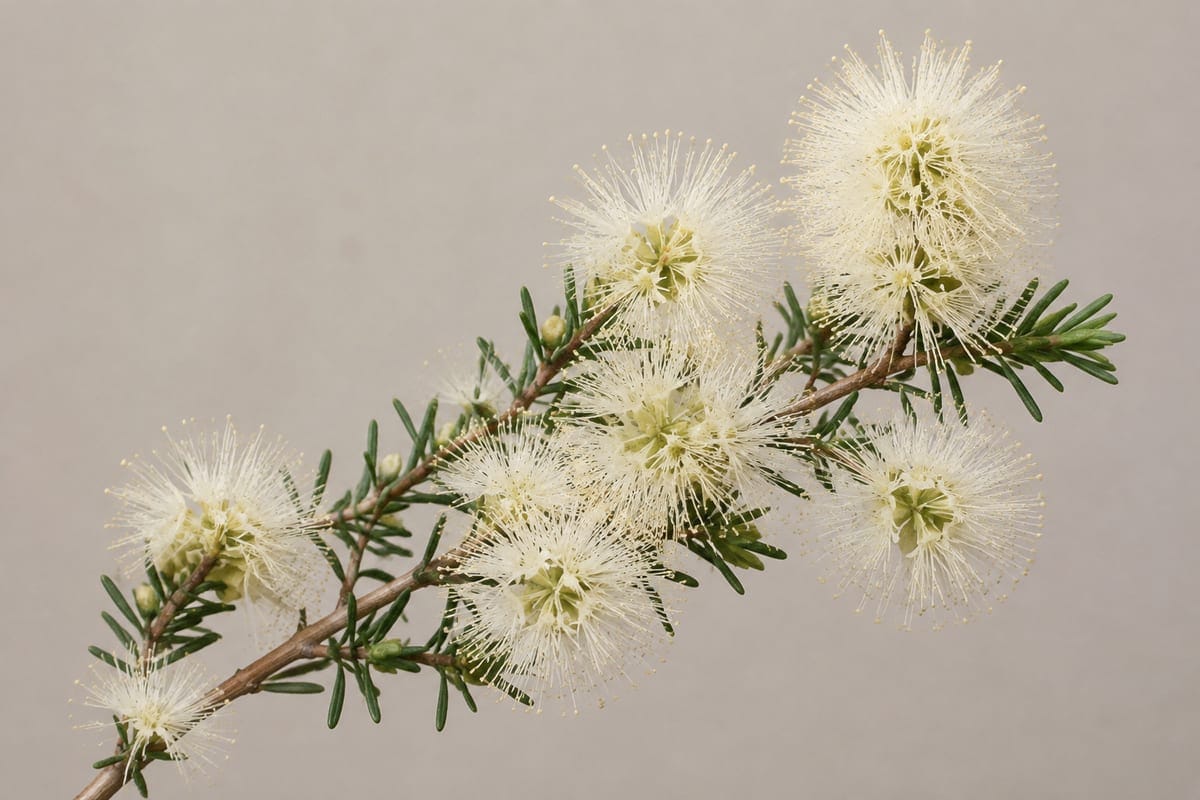
Kunzea ambigua is a shrub in the myrtle family, Myrtaceae, alongside eucalyptus, tea tree and paperbark. It grows one to three metres tall, with fine narrow leaves and, in late spring, clusters of small white flowers with long stamens that give the whole bush a fluffy look from a distance. Bees work it heavily, and Tasmanian beekeepers put hives near it.
It grows on sandy and rocky coastal ground from south-eastern Queensland down through New South Wales and Victoria into Tasmania, and it is common on Flinders Island and the other Bass Strait islands.
It is a coloniser, taking hold on cleared and disturbed ground and spreading, which is why Australian farmers long regarded it as scrub to push off a paddock rather than a crop worth having.
Where the name comes from
The genus was named for Gustav Kunze, a nineteenth-century German botanist and physician at Leipzig. The species name ambigua — ambiguous — records the early uncertainty about whether the plant belonged with the closely related Leptospermum, the tea trees.
In Tasmania it is usually called tick bush. The name comes from an old observation that animals resting under it seem to carry fewer ticks. That is a folk name and a piece of bush lore, not a measurement, and it should be read as one.
A short history
The plant is far older in Australia than any use of it. Claims that Tasmanian Aboriginal people used kunzea medicinally are repeated in a great deal of marketing copy; the documentation behind them is thin, largely second-hand, and rarely cites a source. It is more honest to say that the record is poor than to repeat the claim as established fact.
European botanists described the plant in the early 1800s, and then largely left it alone. For the next century and a half it was a nuisance shrub.
Commercial distillation began in north-eastern Tasmania in the 1990s. The industry grew out of the clearing problem rather than in spite of it: if the bush had to come off the land anyway, the cut material might as well go through a still. That origin still shapes the industry, which remains small — a handful of producers, most of them harvesting wild stands on private land rather than growing plantations.
Where it comes from now
Almost all commercial kunzea oil is Tasmanian, concentrated in the north-east of the state and on Flinders Island.
Tasmania dominates for two reasons. The stands there are dense and accessible, and the oil they yield is consistently high in alpha-pinene, which is the profile the market has settled on. Kunzea growing on the mainland can distil to a noticeably different composition.
Wild harvest has a consequence worth knowing about as a buyer: batches vary. Two drums from the same producer in different seasons are not identical, which is why a batch analysis matters more here than it does for a plantation crop.
How the oil is made
Kunzea oil is steam-distilled from the leaves and the small stems. Cut material goes into a still, steam is passed through it, the vapour is condensed, and the oil separates from the water it comes over with.
The yield is low: roughly one to two per cent of the plant material by weight. A tonne of cut kunzea gives somewhere around fifteen litres of oil.
The result is pale yellow to clear, thin, and smells fresh and green — somewhere between eucalyptus and pine, without the sharp medicinal edge of tea tree.
What is in it
Kunzea oil is a mixture of several dozen compounds. The ones that make up most of it, in the ranges reported for Tasmanian oil:
| Compound | Typical share |
|---|---|
| Alpha-pinene | 35–50% |
| 1,8-Cineole | 10–15% |
| Globulol | 5–10% |
| Viridiflorol | 5–10% |
| Bicyclogermacrene | 3–8% |
| Alpha-terpineol | 2–5% |
| Ledol | 1–3% |
Alpha-pinene is the compound that gives pine needles their smell. 1,8-cineole is the main component of eucalyptus oil. Globulol and viridiflorol are heavier compounds that also turn up in eucalyptus and tea tree oils. The balance shifts with where the plant grew, when it was cut and how it was distilled.
What it is used for
Kunzea oil is sold, in rough order of volume, for these purposes.
Fragrance. Perfumery and scent blending, where it contributes a green, resinous, faintly camphorous note. This is the largest use and the least contentious one.
Massage and body oils. Diluted in a carrier oil, on its own or blended with eucalyptus, lavender or tea tree.
Balms and creams. Included at low concentrations in products applied to skin.
Bath products. It does not dissolve in water, so in a bath product it has to be carried on salt or held in an emulsifier; a few drops poured into a full bath simply sit on the surface.
Household and animal products. Some Australian cleaning products and animal grooming preparations use it, largely on the strength of the tick bush name.
What these have in common is scent and custom rather than demonstrated effect. Kunzea has not been studied at anything like the scale of tea tree, and the published work on it is small and preliminary. The honest position is that it is a distinctive Australian oil with a long folk association and a short evidence record.
Buying it
Look for Kunzea ambigua named on the label, a Tasmanian producer, and a batch analysis showing alpha-pinene as the dominant component. Oil sold simply as "kunzea", with no species given, may come from a different Kunzea species with a different composition.
Expect it to cost more than tea tree or eucalyptus. Low yield, wild harvest and a small number of producers account for the difference.
Essential oils are concentrated. They are diluted in a carrier before going on skin, and a patch test first is sensible for anyone who reacts to mint or eucalyptus oils.
Frequently asked questions
What is kunzea oil?
An essential oil steam-distilled from the leaves and small stems of Kunzea ambigua, a shrub native to south-eastern Australia.
Where does kunzea grow?
From south-east Queensland through New South Wales and Victoria to Tasmania and the Bass Strait islands. Nearly all commercial oil is Tasmanian.
Why is it called tick bush?
From an old observation that animals sheltering under it carried fewer ticks. It is a folk name rather than a measured finding.
Is kunzea the same as tea tree?
No. Both are in the myrtle family, but they are different genera and different oils. Tea tree oil is mostly terpinen-4-ol; kunzea oil is mostly alpha-pinene.
What is kunzea oil used for?
Mostly fragrance, along with massage oils, balms, bath products and some household and animal preparations.
Why is kunzea oil expensive?
Low distillation yield, wild harvesting rather than plantation growing, and very few producers.