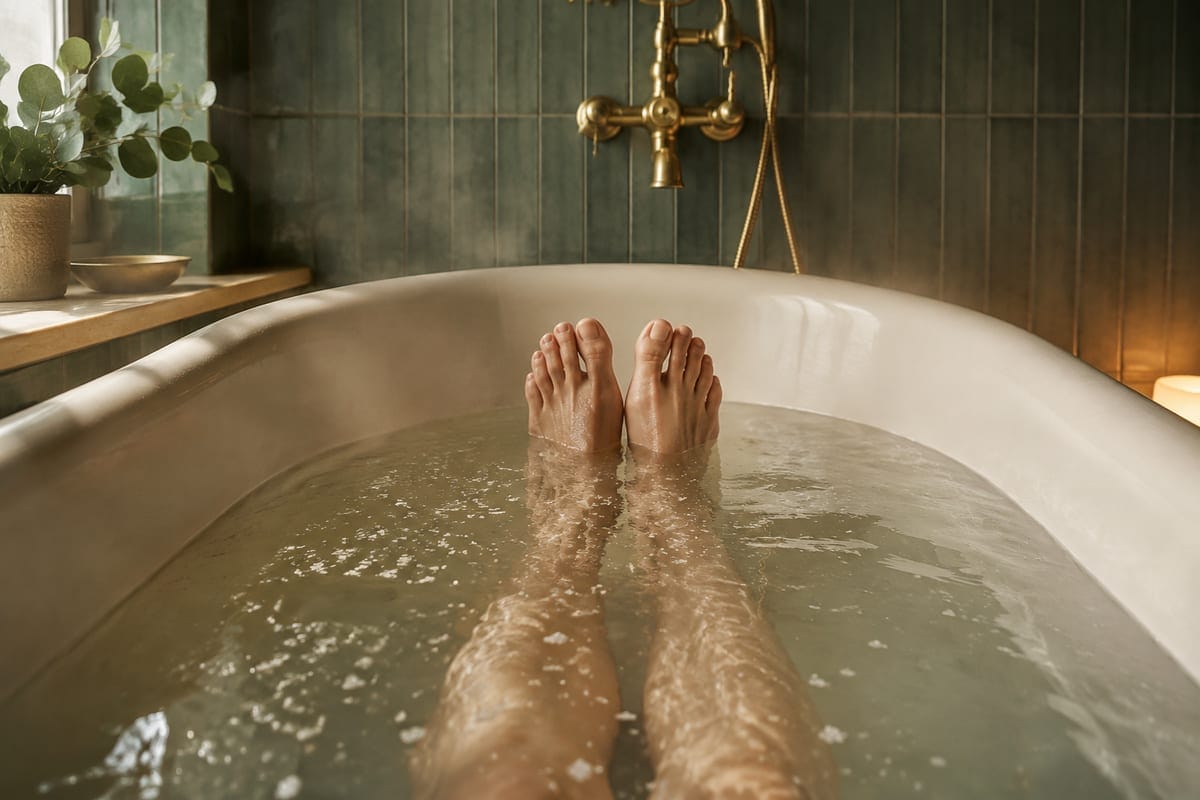
How to make a recovery bath at home
By ThermoPure •
A recovery bath is a bath you take on purpose, after you have used your body — a game, a shift, a long day on your feet — rather than to get clean. This is how to set one up at home without buying anything you don't need.
Warm or cold
Both exist and they are different things.
A warm recovery bath is 37 to 40 °C, which is body temperature to a few degrees above it. It is the bath most people already know how to run. You stay in for 15 to 20 minutes.
A cold plunge is 10 to 15 °C. That is tap-cold in a Melbourne winter and needs ice or a chiller in summer. People new to it stay in for one to three minutes; experienced users go longer. Cold water is uncomfortable by design, and the first minute is the hardest.
Neither is the right answer for everyone. If you have a heart condition, are pregnant, or take medication that affects blood pressure, ask your doctor before starting cold immersion. Warm baths above 40 °C are also a poor idea in those cases.
Getting the temperature right
A kitchen thermometer or a $10 floating bath thermometer takes the guesswork out. Without one:
- 37–38 °C feels neutral — neither warm nor cool on your wrist.
- 39–40 °C feels warm and you will start to sweat within ten minutes.
- Above 41 °C is hot. Most people can't stay in comfortably, and you shouldn't try.
For cold: tap water in southern Australia in winter is 10 to 14 °C. In summer it is 20 °C or more, and you'll need roughly 10 kilograms of ice per 100 litres to bring a tub down to 12 °C.
What to add
Plain water works. Adding minerals changes how the water feels and what is in it.
Magnesium chloride flakes. The most common bath mineral after Epsom salt. About 12 per cent magnesium by weight, dissolves in a few minutes, makes the water feel slightly slick. Sold at around $30 a kilogram.
Epsom salt (magnesium sulphate). The cheap option. About 10 per cent magnesium, coarse crystals, $6 a kilogram at the supermarket. One to two cups per bath.
Dead Sea salt. Mostly magnesium chloride and potassium chloride with a long list of trace minerals. Harvested from evaporation ponds in Israel and Jordan. Less common on its own; usually blended.
Menthol. A compound from mint. In water, it makes the water feel cooler on the skin than the thermometer says. Used in cold plunges to sharpen the cold and in warm baths for contrast.
Essential oils. Eucalyptus, kunzea, peppermint. Added in small amounts for scent. They don't dissolve in water on their own; a formulated soak carries them on the salt.
A formulated soak. ThermoPure® Recovery Bath Minerals is one 250 g pouch containing magnesium chloride, Dead Sea salt, OptiMSM®, menthol and Tasmanian kunzea oil. One pouch is one bath. The point of a formulated product is that the mixing and measuring is done.
How much
For a standard bath of about 150 litres:
| Additive | Amount per bath |
|---|---|
| Epsom salt | 250–500 g (1–2 cups) |
| Magnesium chloride flakes | 250 g–1 kg (sellers vary) |
| Dead Sea salt | 250–500 g |
| ThermoPure® pouch | 250 g (one pouch) |
Pour the salt in while the water is running so it dissolves as the bath fills. If you add it to a full bath, swirl the water; undissolved flakes on the bottom are just flakes that haven't had time yet.
Full bath or foot soak
A foot soak in a basin uses a tenth of the water and a fraction of the minerals, and you can do it sitting at the kitchen table. For people who don't have a bath, or don't have twenty minutes, it is the practical version.
Use a basin big enough to cover the ankles, about 8 to 10 litres. Add 100 to 200 grams of magnesium chloride, or a third to half of a ThermoPure® pouch. Water at the same temperature you'd use for a bath. Ten to fifteen minutes.
Hands work the same way, in a smaller basin.
A simple routine
- Start the water at 38 °C.
- Pour in the minerals while it fills.
- Get in when the bath is three-quarters full and let it finish filling around you.
- Fifteen to twenty minutes. Top up with hot water if it cools.
- Rinse off if you want to; the salt residue is harmless but some people prefer to shower it off.
- Drink a glass of water afterwards. Warm baths make you sweat more than you notice.
For a cold plunge, fill first, check the temperature, get in, and get out when your set time is up rather than when you feel like it — the urge to get out arrives early and passes.
Frequently asked questions
How hot should a recovery bath be?
37 to 40 °C for a warm bath. Above 41 °C is hot enough to be uncomfortable for most people and is not recommended.
How long should I stay in?
15 to 20 minutes in a warm bath. One to three minutes in a cold plunge if you are new to it.
Can I use a recovery soak in a cold plunge?
Yes. Magnesium chloride and the other salts dissolve in cold water, just more slowly. Stir. Menthol in cold water makes the cold feel sharper.
Do I need to rinse off afterwards?
No. Salt residue on the skin is harmless. Rinse if you prefer.
What if I don't have a bath?
A foot soak in a basin, with a third to half the amount of minerals, is the usual substitute.
Can I reuse the bath water?
The minerals stay dissolved, but the water is no longer clean. Drain it.