Magnesium chloride vs Epsom salt: the difference, and which to put in the bath
By ThermoPure • • Updated
Epsom salt and magnesium chloride flakes both go in the bath and both contain magnesium. That is where the similarity ends. They are different compounds, from different places, with different amounts of magnesium in them, and they behave differently in water. This article sets out the facts so you can choose.
What Epsom salt is
Epsom salt is magnesium sulphate heptahydrate, written MgSO₄·7H₂O. Each unit is one magnesium, one sulphate group and seven water molecules. The name comes from Epsom in Surrey, England, where the compound was first boiled down from spring water in the 1600s.
Almost no Epsom salt sold today comes from a spring. It is manufactured by reacting magnesium oxide or magnesium carbonate with sulfuric acid, then crystallising the result. Some is mined as the mineral kieserite and processed. Either way, the product is a white crystal, usually coarse, and it is cheap because the inputs are cheap.
By weight, Epsom salt is about 10 per cent magnesium. The rest is sulphate and water of crystallisation.
What magnesium chloride flakes are
Magnesium chloride flakes are magnesium chloride hexahydrate, MgCl₂·6H₂O. One magnesium, two chlorides, six waters.
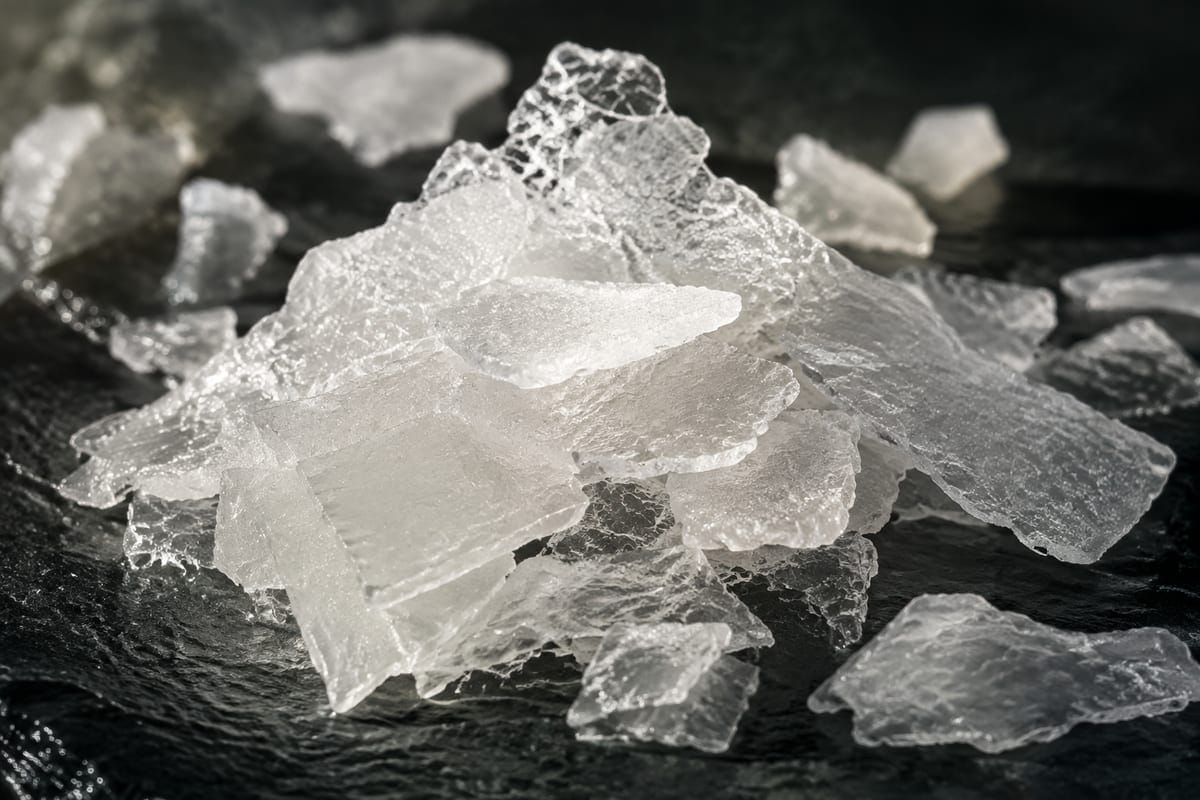
Most flakes are evaporated from brine rather than manufactured. The main sources are the Dead Sea, the ancient Zechstein seabed under the Netherlands and northern Germany, salt lakes in Qinghai, China, and seawater evaporation ponds. The brine is concentrated, other salts are removed, and the magnesium chloride is crystallised into flat white flakes.
By weight, magnesium chloride hexahydrate is about 12 per cent magnesium. Slightly more than Epsom salt, gram for gram.
Magnesium chloride is hygroscopic: it pulls moisture out of the air. Left open, the flakes go damp and clump into a block. This is normal and does not affect what is in them. Keep the bag sealed.
Side by side
| Epsom salt | Magnesium chloride flakes | |
|---|---|---|
| Compound | Magnesium sulphate heptahydrate | Magnesium chloride hexahydrate |
| Formula | MgSO₄·7H₂O | MgCl₂·6H₂O |
| Magnesium by weight | ~10% | ~12% |
| Usual source | Manufactured from magnesium oxide and sulfuric acid | Evaporated from brine (Dead Sea, Zechstein, salt lakes) |
| Form | Coarse crystals | Flat flakes |
| Solubility at 20 °C | ~35 g per 100 mL water | ~54 g per 100 mL water |
| Water feel | Ordinary | Slightly slick |
| Storage | Stable | Draws moisture; keep sealed |
| Supermarket price, AU | ~$5–8 per kg | Rarely stocked |
| Specialist price, AU | ~$8–15 per kg | ~$25–35 per kg |
How much goes in a bath
Epsom salt packaging usually says one to two cups per bath, which is roughly 250 to 500 grams. Magnesium flake sellers suggest anything from 250 g to a kilogram. There is no agreed standard for either, and the figures come from manufacturers rather than from a testing body.
For a standard Australian bath of around 150 litres, 250 g of either compound gives a solution well under one per cent. Both dissolve fully within a few minutes in warm water. Magnesium chloride dissolves faster and at a higher concentration, which matters if you are making a strong foot soak in a small basin rather than filling a tub.
What each costs per soak
Take 500 grams as the bath dose for both.
Epsom salt at $6 per kilogram: about $3 per bath.
Magnesium chloride flakes at $30 per kilogram: about $15 per bath.
A ThermoPure® pouch is 250 g and $19.95, or $14.28 per soak in the seven-pack. It costs more per gram than plain flakes because it is not plain flakes. It is magnesium chloride blended with Dead Sea salt, OptiMSM®, menthol and Tasmanian kunzea oil. If you only want magnesium chloride, buy magnesium chloride; the plain product is cheaper and this article is not going to pretend otherwise.
How the water feels
Dissolved magnesium chloride makes water feel slicker between the fingers, similar to the feel of a soft-water shower. Magnesium sulphate does not do this to the same degree. Neither changes the colour of the water. Neither foams.
Some people say Epsom baths leave their skin feeling drier afterwards and magnesium chloride baths do not. That is a common report, not a measured result.
What the research has looked at
The question people want answered is whether magnesium in bath water gets through the skin into the body. Here is where that stands.
A 2017 review in the journal Nutrients by Gröber and colleagues went through the published work on magnesium applied to skin and concluded that the evidence for meaningful absorption through skin had not been established. The studies it found were small.
A frequently cited experiment by Rosemary Waring at the University of Birmingham, in which volunteers bathed in Epsom salt and had their blood magnesium measured, was circulated as a report in the 2000s and was not published in a peer-reviewed journal.
A 2017 pilot study by Kass and colleagues tested magnesium cream on the skin over two weeks and found a small change in blood magnesium in one group that did not reach the threshold the authors set for significance.
So: the studies exist, they are small, the results are mixed, and reviewers who have gone through them say the question is open. Anyone who tells you the answer is settled in either direction is ahead of the evidence.
What is not in dispute is that both salts dissolve in warm water and change how the water feels, and that a warm bath is a warm bath.
Which to buy
Buy Epsom salt if you want the cheapest magnesium bath and don't mind coarse crystals.
Buy magnesium chloride flakes if you want more magnesium per gram, faster dissolving, and the slicker water feel, and are willing to pay for it.
Buy a formulated soak like ThermoPure® if you want the magnesium chloride plus the other ingredients — the menthol cooling note, the Dead Sea salt, the kunzea oil — in one measured pouch rather than mixing them yourself.
Frequently asked questions
Is magnesium chloride the same as Epsom salt?
No. Epsom salt is magnesium sulphate. Magnesium chloride is a different compound with a different second ion, chloride instead of sulphate, and a different source.
Which has more magnesium?
Magnesium chloride hexahydrate, at about 12 per cent by weight against Epsom salt's 10 per cent.
Can I mix them in the same bath?
Yes. They are both soluble salts and do not react with each other in water.
Why do my magnesium flakes turn into a solid block?
Magnesium chloride absorbs moisture from the air. The block is the same product with water in it. Break it up and use it; keep the bag sealed next time.
How much magnesium chloride for a foot soak?
Sellers suggest 100 to 200 grams in a basin of warm water. Because magnesium chloride is highly soluble, a foot soak can be made much stronger than a full bath for the same amount of product.
Does magnesium sulphate or magnesium chloride absorb through skin?
Small studies have looked at it. A 2017 review concluded it had not been established. See the research section above.